A crackling fire, Frank Sinatra on the turntable, and the warm glow of chartreuse and amber lights across teak furniture set a distinct tone. Holiday trends come and go, but mid-century modern styling offers a relaxed character that big-box store aisles simply miss. You can easily swap generic plastic Santas for original atomic-era charm. Mix an old fashioned and transform your living room into a cozy, retro holiday space.
1. Silver aluminum tinsel trees

Aluminum Christmas trees instantly capture the mood of the atomic era. During the late 1950s, Evergleam popularized these metallic branches, catching and throwing every sliver of ambient room light. You can find original aluminum trees at local estate sales, or purchase a well-made modern reproduction.
Never string electric lights on these branches, because aluminum conducts electricity. Aim a motorized, revolving color wheel at the base instead. As the disc rotates, amber, deep blue, and emerald tones wash across the silver needles, projecting shifting colors across the ceiling and walls.
2. Original Shiny Brite glass ornaments

Max Eckardt introduced Shiny Brite glass ornaments to American homes in 1937, and collectors still seek them out today. These hand-painted bulbs carry concentric stripes, frosted stencils, atomic starbursts, and indented centers that reflect room light. Vintage preservation articles on Architectural Digest explain how to identify genuine period pieces by their metal caps.
Hang them closely on evergreen boughs, or gather extra ornaments inside a low wooden bowl on the coffee table. Sorting these fragile ornaments by color gives them a clean, organized look. If you want more ideas for reflective surfaces, read our guide on glass vase Christmas decor to arrange glassware throughout your home.
3. Teak credenza holiday vignettes

A mid-century sideboard or credenza provides an ideal base for a seasonal display. Lay a simple wool runner in mustard yellow or olive green across the top wood grain.
Vary the heights across the surface by grouping brass candleholders with geometric bottle-brush trees. Mid-century design relies heavily on off-center balance, so avoid symmetrical arrangements. Position a vintage ceramic deer figurine beside your turntable to finish the arrangement.
4. Atomic starburst tree toppers

Skip fabric bows and Victorian angels in favor of an atomic starburst topper. Space Race designs from the 1950s popularized these sharp, radiating brass spikes, Sputnik spheres, and faceted glass centers.
A brass starburst anchors the top of the tree and pulls the eye upward. You can match the metal finish on your topper to your floor lamps or drawer pulls to connect the tree with the rest of the room.
5. Ceramic trees with multi-colored pegs

Many families still treasure hand-cast ceramic Christmas trees from the 1960s and 1970s. A single bulb inside the hollow ceramic base lights up small, translucent plastic pegs fitted into the branch tips.
Set one on an entryway table or a low shelf. The small bulbs provide soft, colorful accent lighting that looks especially cozy once you turn off the overhead lamps at night.
6. Earthy, saturated retro color palettes

Mid-century interiors step away from plain candy-cane red and forest green. Instead, choose shades that mid-century designers favored: chartreuse, burnt orange, mustard, deep teal, and muted pink paired with dark walnut woods.
Tuck these warm tones alongside natural evergreen boughs. If you enjoy organic textures, our guide to organic Christmas decor ideas shows how to balance rich retro tones with fresh cedar and eucalyptus branches.
7. Asymmetrical mantle garland

Mid-century homes frequently feature asymmetrical brick or fieldstone hearths. Emphasize those crisp horizontal lines by hanging an unbalanced holiday garland. Drape pine boughs and magnolia leaves down one side of the mantel shelf, leaving the opposite side bare.
Fasten geometric brass bells, natural wooden beads, and sliced dried oranges into the foliage. This arrangement frames the stonework without hiding it. For historic examples of mid-century fireplace design, consult Atomic Ranch.
8. Sputnik chandeliers with seasonal greens

The sputnik fixture remains one of the most recognizable lighting designs of the atomic era. You can decorate yours for December by loosely weaving lightweight greens like Italian ruscus or cedar around the metal arms. Always leave safe clearance around the bulbs to prevent dry foliage from overheating.
Tie a few light glass ornaments to the brass rods using clear monofilament. When you switch on the chandelier, the foliage casts patterned shadows across the ceiling and turns the fixture into a hanging centerpiece above the dining table.
9. Geometric wool stockings on brass hooks

Replace fuzzy velvet stockings with thick felted wool versions patterned with diamonds, boomerang arcs, or grids. Mid-century textiles relied on these repeating geometric motifs.
Select colors like burnt sienna, olive drab, and cream. Mount simple brass hooks along the underside of the mantel shelf to hang them. You can use identical stocking shapes while varying the printed patterns to give the row an orderly look.
10. A mid-century bar cart for holiday drinks

Set up a brass-and-walnut bar cart to serve drinks during holiday get-togethers. Stock the shelves with amber glassware, glass decanters, a stainless or brass shaker, and fresh citrus garnishes.
Tuck a small rosemary topiary or winterberry sprigs beside the ice bucket. You can also wire a small cedar wreath to the front handle. This gives guests an accessible spot to mix drinks throughout the evening.
11. Wire and molded chairs draped with sheepskins

Mid-century seating relies on industrial materials like molded plywood, fiberglass, and welded wire. Drape long-wool sheepskins or heavy woven throws across wire chairs to make them comfortable for cold winter nights. You can find similar styling suggestions in our collection of warm Christmas decor ideas.
Natural wool softens the steel wire and prevents chilly drafts. Add a small lumbar pillow in burnt orange or gold wool to complete the seat.
12. Fold-out honeycomb paper bells
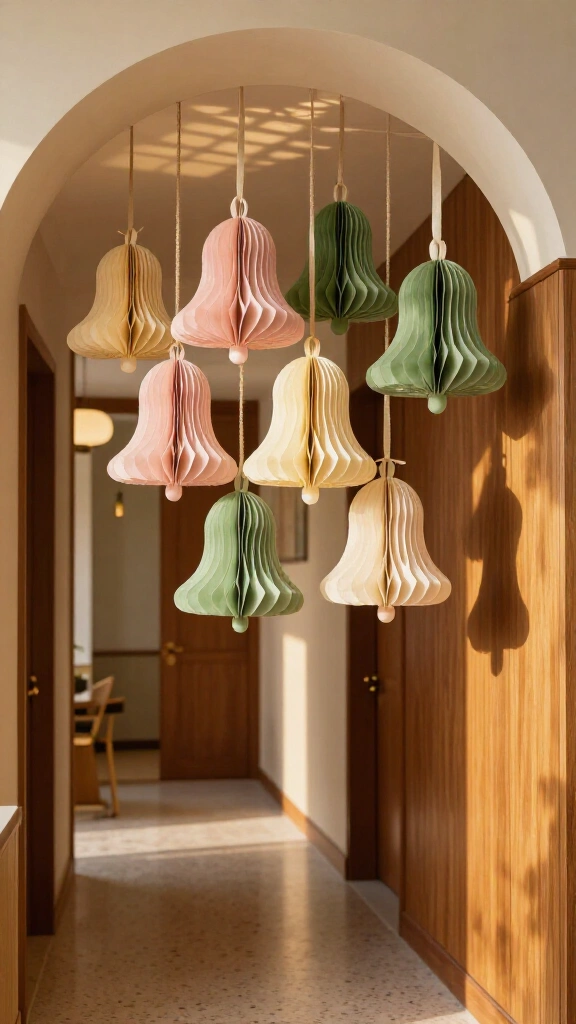
Accordion paper bells and garlands offer an affordable way to decorate large rooms. Throughout the 1950s and 1960s, homeowners hung these lightweight paper decorations across archways, windows, and light fixtures.
Hang clusters of paper bells in muted shades (such as avocado, blush, and cream) down a hallway ceiling. They fold completely flat after the holidays, saving valuable storage space in your closets.
13. Walnut and brass candelabras

Danish designer Jens Quistgaard popularized sculpted wooden candleholders during the late 1950s and 1960s. Look for tiered teak or walnut stands that hold slender taper candles in cream or beeswax yellow.
Place these wooden candleholders down the center of your dining table alongside small pine cones and greenery. Real candlelight illuminates the rich grain of the turned wood. The Smithsonian archives document how Danish woodcraft shaped American interior decorating throughout the post-war era.
14. Wooden dowel trees

For a clean, geometric silhouette, replace a bushy tabletop evergreen with a wooden dowel tree. Craftsmen make these tabletop trees from birch, pine, or walnut, fitting horizontal slats through a center post in a spiral pattern.
These open wooden arms let you hang your rarest vintage glass ornaments without crowded branches hiding them. The design reflects the mid-century focus on visible structure and functional materials.
15. Diamond-patterned gift wrap

Wrapped presents beneath the tree contribute directly to the look of your living room. Wrap packages in heavy matte paper printed with mid-century patterns like harlequin diamonds, atomic starbursts, or stylized snowflakes.
Tie the parcels with cotton twill ribbon or butcher twine instead of stick-on plastic bows, and slip a sprig of fresh cedar under the knot. These coordinated packages give the base of your tree a finished appearance.
Tips for authentic mid-century holiday styling
- Check local estate sales: Genuine vintage decorations show age, hand-painted lines, and subtle wear that reproductions rarely capture.
- Use off-center balance: Avoid mirror images on mantels and sideboards. Place taller items on one side and counterbalance them with smaller groupings on the other.
- Mix warm and cold textures: Balance brass, chrome, and glass with walnut grain, wool fabrics, and fresh evergreen clippings.
Decorating with mid-century pieces does not require turning your home into a museum exhibit. When you combine original ornaments, geometric paper accents, and warm wood furniture, you build a festive space that feels comfortable and personal. Put a holiday record on the turntable, pour a drink, and enjoy the season with classic style.