Remember staring into the branches of a Christmas tree as a kid, mesmerized by the reds, greens, and blues? Over the last decade, minimalist all-white bulbs took over social media, swapping saturated color for sterile catalog looks. We want that color back. When the sun dips below the horizon, multicolored bulbs cast a warmth across pine needles that clear lights simply cannot match.
You do not have to settle for a chaotic tangle that resembles a carnival midway. These 14 techniques help you layer and style colorful tree lights with real intention, giving your living room deep color and sharp evening contrast without looking messy.
1. Nostalgic vintage C9 ceramic glow

Classic, oversized C9 bulbs with opaque ceramic finishes instantly ground a tree in mid-century style. Translucent glass often projects sharp beams against your drywall, but ceramic coatings soften the light into a steady, rich halo along each branch. They echo living rooms from the 1960s while saturating the room with deep tones the moment you switch off your ceiling fixtures.
Pair these larger lights with heavy glass ornaments to balance the scale. If you prefer older holiday styles, combine these bulbs with ideas from our guide to old world Christmas decor. Push the bases of the ceramic sockets into the interior branches so the tips point outward from within the foliage.
Pro tip for C9 bulbs
- Use modern LED reproductions: Newer LED versions match the look of painted incandescent bulbs without overheating or tripping circuit breakers. Energy Star decorative lighting standards confirm these models draw a fraction of the wattage.
- Space your strands evenly: Hang roughly one strand per vertical foot of tree height so the bulbs do not crowd the boughs.
2. Micro-fairy jewel-tone clustering

Replace heavy green cables with micro-fairy strands built on thin copper wire. Wrap hundreds of amber, magenta, sapphire, and emerald points directly around individual branch tips. The copper wiring hides against the needles, leaving what looks like a suspended cloud of colored fireflies when you dim the lamps.
The small scale eliminates harsh glare while providing crisp saturation. Guests usually walk right up to the branches just to see how the lights attach. The technique gives multicolored lighting a tidy, tailored finish.
3. Deep-core luminescence with trunk wrapping

Many people lay lights solely across the outer perimeter of their branches. For better results after dark, start at the tree base and wind your multicolored strands tightly around the central trunk and the root of every main branch. Work outward along the limbs toward the tips to illuminate the tree from the inside out.
This approach casts a strong interior glow that outlines your hanging ornaments from behind. It removes dark hollows near the trunk and makes the entire tree look fuller in a dark room. Depth builds contrast, and lighting the trunk establishes that foundation immediately.
4. Vertical ombré rainbow melt

Multicolored lights do not need to look random. You can organize your tree by building a vertical ombré gradient from top to bottom. Use programmable RGB smart strands (or grouped single-color micro-lights) so deep violet shifts into sapphire blue, emerald green, warm gold, and dark red as the eye moves down the tree.
This arrangement complements modern interiors that rely on clean lines. You get the fun of a full color palette while keeping the overall design structured and tidy.
5. Silver tinsel light reflectors
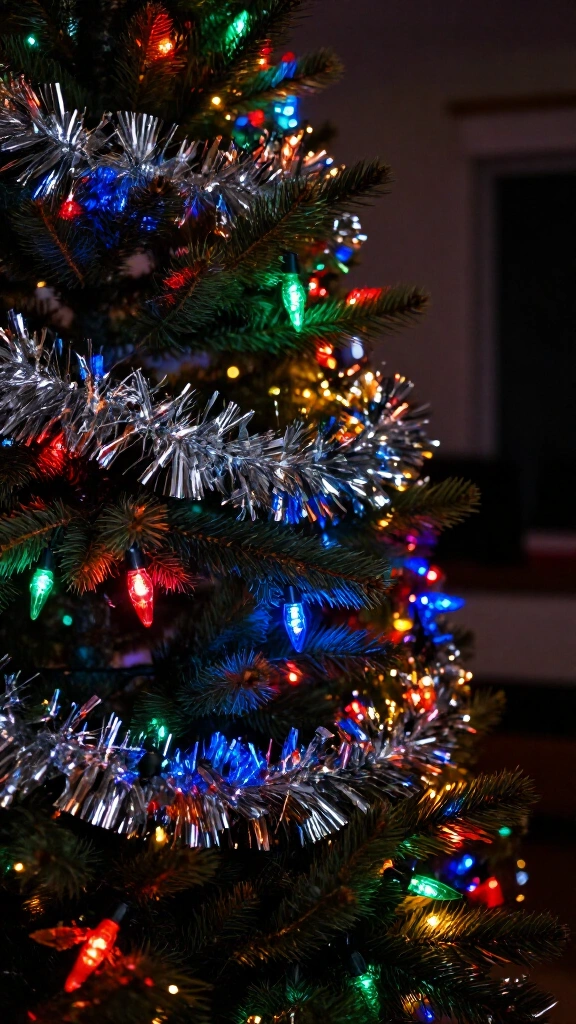
You can multiply the brightness of your tree without running extra extension cords. Hang silver mylar tinsel directly beside your colored bulbs. The reflective metallic strips act like tiny mirrors, bouncing red, blue, and green light back across the room.
The foil catches drafts in the room, creating subtle movement that mimics lights reflecting on wet pavement. Records at the Smithsonian Institution explain that early decorators relied on lead and mylar foil to amplify low-wattage bulbs. Hang the strands one by one near the tips of the branches to capture that mid-century reflective shine.
6. Snow-flocked neon contrast

Heavy flocking serves as an effective diffuser for saturated colored bulbs. Dark green needles tend to swallow light, but white flocking catches and spreads the illumination across each bough. Violet and cyan bulbs turn the artificial snow into soft pastel patches that resemble a snow-covered mountain cabin at dusk.
This pairing suits homes with rustic, winter-focused accents. You can pair this frosted look with raw wood and wool textures from our cabin Christmas decor guide to reinforce the cold-weather atmosphere.
7. Mirrored mercury glass reflections

Place fluted, antiqued mercury glass ornaments directly next to individual colored bulbs to expand their reach. The mottled, silvered coating diffuses pinpoint glare and casts colored patterns across your ceiling and walls.
Mercury glass scatters light in irregular directions, giving static light strands a layered appearance. Choose clear or champagne-tinted glass baubles so the colored bulbs establish the room palette without clashing against painted ornaments.
8. Dual-layer warm white and multicolor lighting

You do not need to choose between warm white and multicolored strands. You can run both. String a dense base layer of steady, 2700K warm-white mini lights along the inner boughs to produce a golden center. Next, drape larger multicolored globes along the outer branches.
The white core illuminates your favorite ornaments clearly so their details remain visible. At the same time, the outer colored bulbs supply the playful look of a traditional holiday tree. This dual setup solves the common household argument over light styles.
9. Velvet ribbons and jewel tones

Balance bright multicolored bulbs by tucking heavy cotton-velvet ribbon into the branches. Drape plum, navy, or forest-green ribbons vertically down the tree. The plush fabric absorbs excess glare along its folds while letting soft illumination spill out from behind the fabric.
The matte texture of the velvet tones down the brightness of the bulbs. You can introduce warm metal accents using ideas from our copper Christmas tree color schemes to tie the rich ribbon fabric to the colored light strands.
10. Mid-century modern Shiny Brite styling

Embrace mid-century holiday style by pairing saturated incandescent bulbs with vintage Shiny Brite glass ornaments. Look for ornaments with concave indented centers, sometimes called reflector ornaments. Place your colored bulbs directly facing these indented pockets so the silvered curves reflect the light back into the room.
This combination mimics retail displays from the 1950s. Top the tree with a wired starburst finial using identical bulbs to pull the entire retro theme together.
Hallmarks of the mid-century tree
- Concave glass ornaments placed directly in front of light sockets.
- Spun-glass or tinsel garlands woven between branches.
- A wire atomic star topper wired with multicolored bulbs.
11. Smart pixel custom animations

Addressable smart LED strands from makers like Twinkly offer precise control over every bulb on the tree. You map the position of each light using your smartphone camera, then program custom color fades, slow rainbow transitions, or subtle firelight effects across the branches.
You can keep the lights on a steady, muted multicolor palette during dinner, then switch to an active pattern later in the evening. The software lets you control individual bulb colors directly from your phone without adjusting physical strings.
12. Matte dark ornaments with localized light pools

Surround your multicolored strands with matte black, dark slate, and deep indigo glass spheres. These non-reflective surfaces absorb background shadows while catching concentrated pools of colored light along their curved faces.
This dark background prevents adjacent colors from bleeding together into a fuzzy wash. Each bulb remains a distinct point of light against the dark baubles, giving your tree crisp visual separation after dark.
13. Frosted opal globe diffusion

If bare LED pinpoints feel too sharp in a dark room, install strands with frosted G40 or G50 globe covers. The milky white glass diffuses the harsh LED diodes, turning them into soft spheres of color that are easy on the eyes.
During the day, the larger white globes look like clean graphic spheres scattered across the branches. At night, they act like small lanterns, distributing an even glow across the room rather than projecting sharp light cones onto your walls.
14. Color-blocked ornament zoning

Organize your decor around specific light pockets by grouping ornaments by color. Hang blue glass balls directly beside blue bulbs, red baubles around red lights, and gold ornaments next to amber points. When you turn on the tree, each bulb lights up matching ornaments in its immediate zone.
This technique brings clear structure to a standard multicolored strand. The tree displays distinct color pockets rather than a random scattering of points, creating a clean look visible from across the room and through front windows.
Set your tree up for the evening
Holiday decorating rewards personal taste, and multicolored lights bring an energy that plain white bulbs cannot reproduce. Classic ceramic C9 globes, custom smart pixel mapping, and deep velvet ribbons all give you distinct ways to light your evergreen once the sun sets.
Pick the method that fits your room, gather your strands, and bring saturated color back to your living room this winter.