Home Comfort

How to Choose the Right Dehumidifier Size for Damp Basements

By Elena Rodriguez, Chief Product DesignerJune 11, 202611 min read

Excess moisture in a home is a silent threat. High humidity levels—particularly in basements, crawlspaces, and laundry rooms—foster the growth of mold, mildew, and dust mites. These allergens aggravate respiratory conditions like asthma and allergies. Furthermore, excess airborne moisture can warp wood floorboards, swell door frames, and rot structural wood studs over time. A dehumidifier is the most effective way to regulate humidity, but you must choose the correct size. An undersized unit will run continuously without reaching target humidity, raising your energy bill and wearing out the compressor prematurely.

Choosing the correct dehumidifier requires looking at both the size of the room and the moisture level in the air. Basements are particularly prone to high humidity because they are surrounded by damp soil and have poor natural ventilation. In this comprehensive guide, we will analyze dehumidifier capacity metrics, evaluate relative humidity guidelines, outline a step-by-step sizing walkthrough, and discuss continuous drainage options.

Relative Humidity (RH) and Psychrometric Baselines

To control humidity effectively, it is helpful to understand Relative Humidity (RH). RH measures the amount of moisture in the air relative to the maximum amount the air can hold at that specific temperature. Hot air holds more moisture than cold air. In basements, which are naturally cooler (often 55°F to 65°F), the relative humidity rises as warm upstairs air settles downstairs and cools down. If the relative humidity in your basement exceeds 55%, mold spores will germinate within 24 to 48 hours. Dust mites, which feed on skin flakes and require ambient humidity to survive, multiply rapidly in RH environments above 60%. A properly sized dehumidifier prevents these issues by extracting moisture to keep the relative humidity consistently between 45% and 50%.

Continuous Drainage Plumbing: Gravity vs. Condensate Pumps

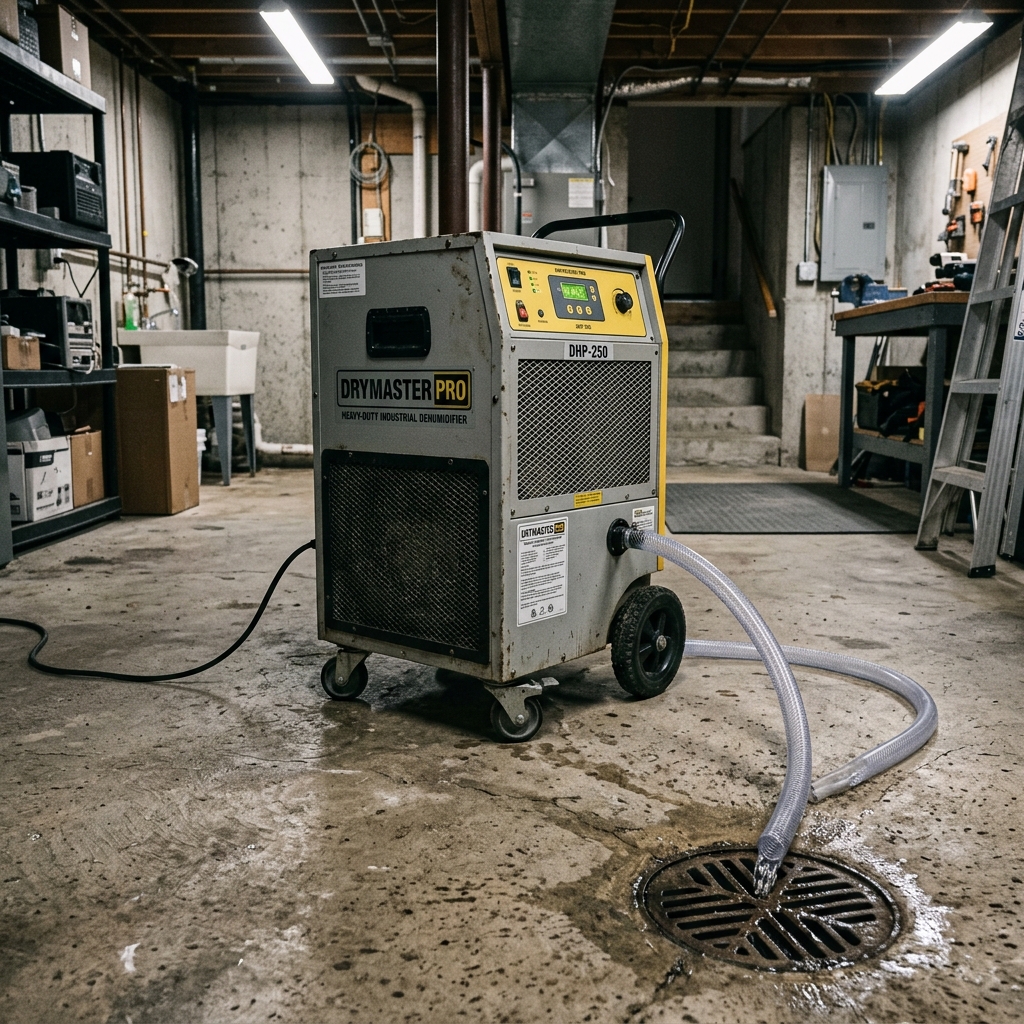
Emptying a dehumidifier's water collection bucket daily can quickly become a tedious chore, and if you forget, the unit's automatic float switch will shut it off, allowing humidity to rise again. To avoid this, utilize a continuous drainage setup. If your basement has a floor drain or sump pump basin, you can connect a standard garden hose to the unit's gravity drain port. This allows water to run down and exit automatically, but the unit must sit higher than the drain. If your drain is located higher than the unit (e.g. a laundry sink) or you don't have a floor drain, you must use a condensate pump. This pump collects the water and pumps it vertically through a thin plastic tube to an exit window or sink, ensuring your basement remains dry without manual maintenance.

Understanding Dehumidifier Capacity (Pints Per Day)

Dehumidifiers are sized by the volume of water they can extract from the air in a 24-hour period, measured in Pints Per Day (PPD). This rating has nothing to do with the physical size of the water collection bucket. Capacity requirements are determined by the square footage of the room and the severity of the dampness:

  • Moderately Damp (60-70% RH): The air feels damp and has a musty odor only when it is humid outside. Requires a base of 10 Pints Per Day for a 500 sq ft room, plus 4 PPD for every additional 500 sq ft.
  • Very Damp (70-80% RH): The space smells musty constantly, and the floor feels damp. Requires 14 Pints Per Day for 500 sq ft, plus 5 PPD for every additional 500 sq ft.
  • Wet (80-90% RH): Moisture beads are visible on walls or windows, and mold spots are beginning to grow. Requires 18 Pints Per Day for 500 sq ft, plus 6 PPD for every additional 500 sq ft. Check your space with our Dehumidifier Sizer.
  • Extremely Wet (90-100% RH): Wet spots or standing water puddles are present on the floor. Requires 22 Pints Per Day for 500 sq ft, plus 7 PPD for every additional 500 sq ft.

ASHRAE Relative Humidity Guidelines

The American Society of Heating, Refrigerating and Air-Conditioning Engineers (ASHRAE) recommends maintaining indoor relative humidity (RH) between 30% and 50% for optimal comfort and health. Humidity levels below 30% can cause dry skin, respiratory irritation, and wood furniture shrinking, while levels above 50% encourage mold growth and dust mite colonization. In crawlspaces and basements, professional standards recommend installing a dehumidifier with a continuous drainage hose connected to a sump pump or condensate pump, eliminating the need to empty water buckets manually. Additionally, look for units certified by AHAM (Association of Home Appliance Manufacturers) to ensure performance testing standards are met.

Step-by-Step Dehumidifier Sizing

Determine the ideal dehumidifier size using these steps:

  • Step 1: Calculate Room Area: Measure the length and width of the space in feet. Multiply them to find the square footage.
  • Step 2: Assess Dampness Vibe: Read our dampness descriptions and select the category that best matches your space.
  • Step 3: Determine Required Pints: Use our capacity guidelines to find the required Pints Per Day. (e.g. a 1,500 sq ft wet basement requires 30 PPD).
  • Step 4: Account for Climate Factors: Add 5 PPD if the room is located in a highly humid climate, or if multiple wash/laundry machines operate nearby.
  • Step 5: Select Drainage Method: Choose between bucket drainage (requires manual emptying) and gravity/pump drainage (continuous).

Types of Dehumidifiers: Compressor vs. Desiccant

When buying a dehumidifier, you will choose between compressor-based and desiccant-based models. Compressor dehumidifiers are the most common. They work by drawing air over cold coils, causing moisture to condense and drip into the bucket. They are highly efficient in warm spaces (above 65°F), but their efficiency drops significantly in cold basements, where frost can build up on the coils. Desiccant dehumidifiers, on the other hand, use a chemical rotor to absorb moisture from the air, which is then heated and evaporated into the collection tank. They work exceptionally well in cold temperatures (below 50°F) and operate quietly, though they consume more electricity. If you are conditioning a cold basement in winter, a desiccant model or a compressor model with an active defrost cycle is essential to prevent freeze-ups. By choosing the right capacity and technology, you maintain healthy relative humidity and protect your home's foundation.

💧

Need to calculate measurements for your space?

Use our free, interactive Dehumidifier Sizer to calculate dimensions, box requirements, or guidelines automatically.

Size Your Dehumidifier
← Back to all blog posts